
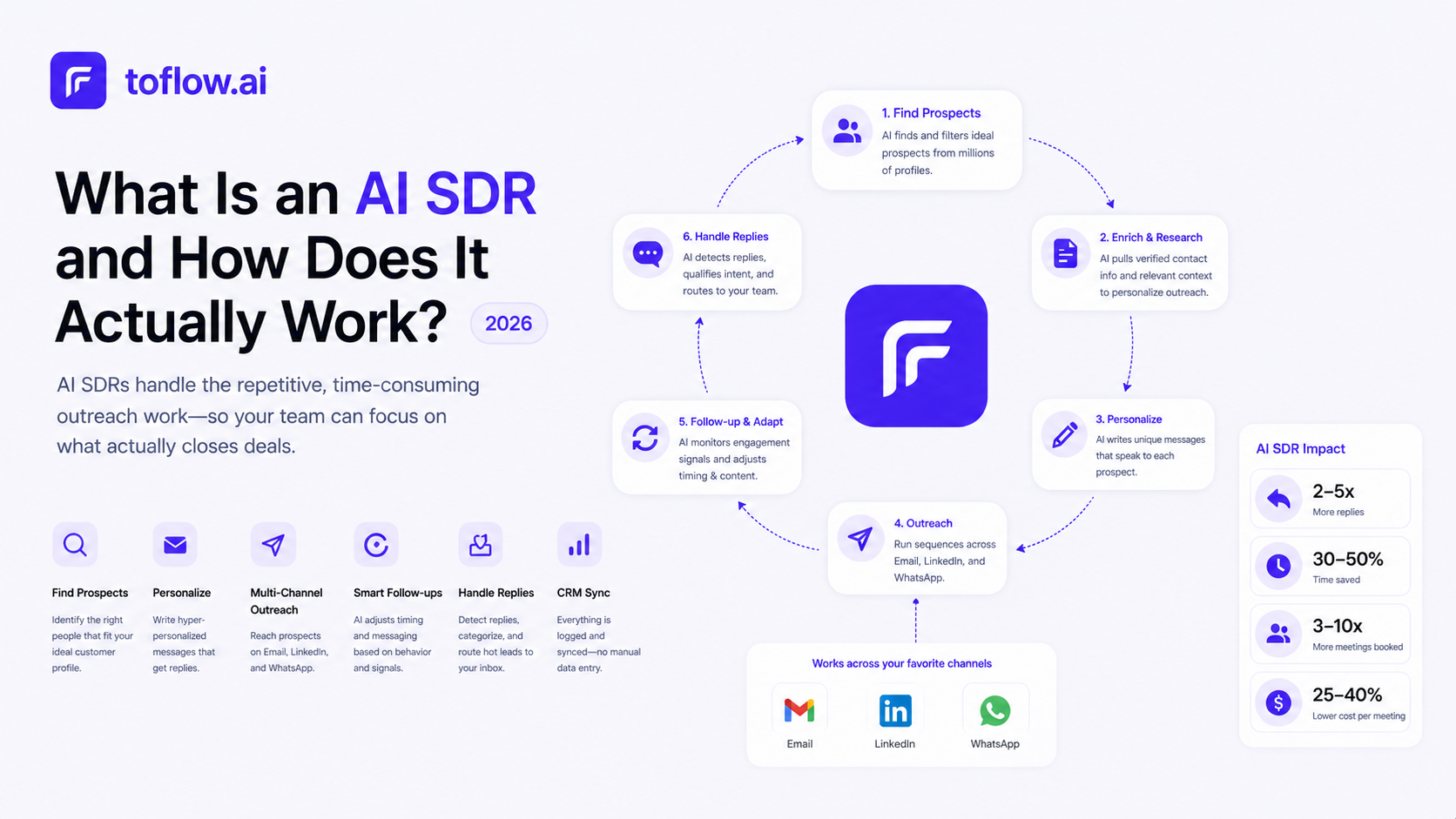

AI SDRs are one of the more discussed topics in B2B sales in 2026, and most of the coverage lands in one of two places. Either it is a claim that AI will replace your entire sales team, or a dismissive take that it is just email automation with a new name on it.
Both miss the point. An AI SDR is a specific thing, it solves a specific problem, and understanding what it actually does and what it does not is more useful than either framing.
What an AI SDR Is
A traditional SDR spends most of their day on a short list of repetitive tasks: building prospect lists, finding contact information, writing outreach messages, sending follow-ups, and logging everything in a CRM. These tasks are important. They are also largely mechanical.
An AI SDR handles these tasks autonomously. Not by automating each step with fixed rules, but by using AI to make decisions at each stage: who to contact, what to say, when to follow up, and how to adjust based on what is actually happening in the pipeline.
The difference from traditional automation comes down to signal-based reasoning. A sequence tool sends message 2 on day 5 regardless of what the prospect did after message 1. An AI SDR reads signals, whether an email was opened multiple times, whether a prospect visited your pricing page, whether they accepted a connection request but did not reply, and adjusts based on what it observes.
You will also see this category called AI BDR, short for AI Business Development Representative. The functions are the same. Whether a company uses SDR or BDR as the title depends on how they structure their sales team, not on any meaningful difference in what the technology does.
The Components of an AI SDR
Most outbound sales automation tools and AI SDR systems are built from the same core layers, even if different products weight them differently.
Prospecting. AI prospecting starts here: the system identifies who fits your ICP from a contact database, using filters like job title, seniority, company size, industry, and geography. More capable systems layer in behavioral signals: companies that are hiring for roles related to your product, prospects who recently changed jobs, accounts showing intent signals.
Enrichment. Once a prospect is identified, the system pulls verified contact information, recent company news, and context that can shape the outreach angle. Good enrichment is what separates a message that opens with a specific reference from one that opens with "Hope this finds you well."
Personalization. The AI uses enrichment data to write messages specific to each prospect. Not filling in a name and company field in a template, but generating copy that references something real: a post the prospect published, a company milestone, a pain point that maps to their industry. The message sends automatically. It just does not read like it was automated.
Sequencing. The system runs outreach across channels at defined intervals, typically email and LinkedIn, with more advanced platforms extending to WhatsApp. The sequence adapts based on behavior rather than running on a fixed timer.
Follow-up. Most replies come on the second or third touch. The AI monitors for responses, manages timing, and in some systems sends initial follow-ups before a human takes over. Contacts who show engagement signals get accelerated. Contacts who have gone cold get a different angle or a lower frequency.
CRM sync. Activity logs, contact records, reply categorization, and pipeline updates all happen automatically. Reps see what the AI did without having to log it manually.
How the Workflow Actually Runs
Here is what using an AI SDR looks like in practice.
You define the target: operations leaders at Series B SaaS companies in the US, between 50 and 500 employees, no existing relationship with your team.
The system builds the list. It pulls contacts that match, verifies emails, finds LinkedIn profiles, and enriches each record with company context and recent activity. For 200 contacts, this takes minutes.
You review the first batch of outreach drafts. The personalization looks accurate, the tone matches how your team communicates, the angles are relevant to the personas. You approve and the sequences go live.
Connection requests go out on LinkedIn. Emails follow. The system watches for opens, clicks, and replies. A prospect who opened an email four times but did not reply gets a follow-up sooner than planned. One who did not open gets a different subject line on the next touch.
Replies land in a shared inbox, already categorized. Interested replies go to a rep immediately. Not-now replies are flagged for follow-up in 30 or 60 days depending on the reason. Wrong-person replies are marked and removed from the sequence.
The rep's job shifts from doing the outreach to reviewing what the AI is doing, handling the real conversations, and making judgment calls on edge cases.
Want to see this running for your team? Book a demo and we will walk through the full workflow live.
What AI SDRs Cannot Do
The question that comes up most is whether AI can replace SDRs entirely. In practice, it replaces the mechanical work, not the role. Being specific about those limits matters, because the gap between expectation and reality is where teams end up frustrated.
They do not replace relationship-based selling. Complex enterprise deals, partnerships, anything where trust is built over months with multiple stakeholders, still requires humans. The AI handles cold outreach volume. It does not close.
They require good ICP definition. The system amplifies your targeting. A vague ICP produces high volume, low quality outreach at speed. The targeting work is still yours to do.
They cannot recover from bad data. If enrichment is wrong, personalization is wrong. An AI SDR sending a message that references a job a prospect left two years ago does more damage than a generic message would have.
First replies still need humans. An AI SDR can identify interest and categorize what came in. Handling the reply, answering specific questions, building rapport from there, that requires a person.
Where AI SDRs Work Best
Knowing when to use an AI SDR versus a human is a more useful question than which is better. The AI SDR vs human SDR comparison is a false trade-off. They cover different parts of the job. The AI handles volume and mechanical execution. The human handles live conversations and decisions that require judgment. The strongest results come in situations where each is doing what it is actually good at.
Teams with a well-defined ICP and consistent messaging get the most out of AI SDRs. When the targeting is precise and the value proposition is clear, the AI can run high volumes without degrading quality. When both are vague, the AI just produces vague outreach faster.
Markets where LinkedIn and email are primary channels are a natural fit. Regions where WhatsApp is used for business communications, particularly India, Southeast Asia, Latin America, and the Middle East, open up a third channel that most competitors are not using effectively.
Smaller sales teams or founders doing their own outreach benefit from AI SDRs because the system extends their capacity without requiring additional headcount. A two-person sales team can run outreach at the volume of a team of eight if the AI is handling the mechanical work correctly.
If your team fits one of these situations, book a demo and we can show you what the numbers look like for your specific setup.
How toflow.ai Approaches This
toflow.ai is built as an AI-native outreach platform. The AI is not a feature layered onto a sequence tool. It is the foundation the whole platform runs on.
The system runs an end-to-end agentic pipeline. It finds prospects matching your ICP, researches each account, and qualifies contacts before spending any enrichment credits. Email and phone lookup only runs on contacts that pass. It reads load across your connected email, LinkedIn, and WhatsApp accounts, assigns each prospect to the right channel mix and sending account, and enrolls them into sequences.
Once a sequence is live, the platform handles execution. Steps go out on schedule, engagement signals adjust timing, and when a reply comes in the sequence pauses automatically. The agent reads the reply in context and decides what happens next: route to a rep, flag for follow-up, or re-enroll under a different contact.
We wrote a full breakdown of how this pipeline works under the hood, including the architecture decisions, the hard parts, and what building agentic systems on MCP actually looks like in practice. Read the engineering article.
Book a demo now. Two weeks free trial, no credit card required.
Frequently asked questions
What is an AI SDR?
An AI SDR is a system that automates the mechanical work of outbound sales development: finding prospects that match an ICP, enriching contact data, writing personalised outreach messages, running sequences across channels, and managing follow-ups based on engagement signals. It does not replace the rep's role in live conversations and judgment calls. It handles the repetitive groundwork so reps can focus on the moments that require a human.
What are the core components of an AI SDR system?
The main layers are prospecting (identifying contacts that match the ICP), enrichment (pulling verified contact information and account context), personalisation (generating messages that reference something specific about each prospect), sequencing (running outreach across email and LinkedIn, with more advanced platforms extending to WhatsApp), follow-up automation (adapting timing and channel based on engagement signals), and CRM sync (logging every activity without manual data entry from reps).
What can AI SDRs not do?
They do not work well for relationship-based enterprise deals where trust is built over months across multiple stakeholders. They require a well-defined ICP to produce quality outreach — a vague ICP just means more low-quality messages sent faster. They cannot recover from bad enrichment data, and they cannot handle replies that require reading tone, answering specific questions, or adjusting based on how the conversation is developing. The person receiving the outreach is still a human, and some parts of the exchange require human judgment.
What is the difference between an AI SDR and traditional outreach automation?
Traditional outreach automation executes a fixed sequence on a timer. An AI SDR adapts. It researches each prospect individually before writing the outreach, generates messages specific to that person rather than filling variables into a template, and adjusts follow-up timing and channel based on whether the prospect is engaging. The output reads and behaves differently because the inputs and logic are different, not just the speed of delivery.